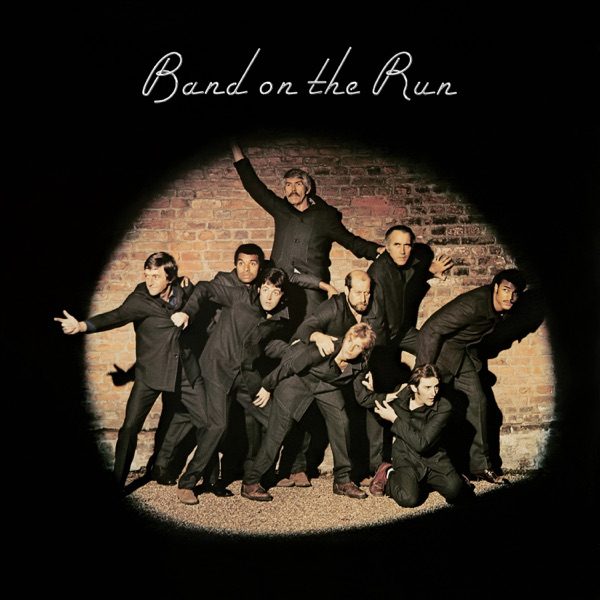
This album review covers Paul McCartney and Wings’ Band on the Run (1973), a prison-break rock record built by a three-piece in Lagos and London, and the moment McCartney’s solo work stopped sounding like a demo.
In September 1970, a shift graced the pages of Melody Maker magazine that was so seismic, it was covered on news broadcasts on British TV. For the first time in eight years, readers had voted for a group other than the Beatles as the world’s most popular group. Less than six months prior, fans had been clinging to the hope that the increasing messiness of their long, drawn-out split would all blow over. Maybe a trial separation, complete with McCartney’s self-titled solo debut from that April, would help everyone come to their senses and realize they were better off still making music together. Less than four months later, McCartney sued the other three Beatles in London’s High Court of Justice to dissolve the band’s contractual partnership with Apple and Allen Klein. John Lennon’s scathing “How Do You Sleep?”, one of pop’s most notorious diss tracks, played not an insignificant role in painting McCartney as the real villain in the Beatles’ breakup. “A pretty face may last a year or two,” he sings midway through. “But pretty soon they’ll see what you can do.”
It didn’t help that Sir Paul’s first couple of solo records, as well as his first one with his new band, Wings, weren’t well-received by critics. Publications like Rolling Stone and reviewers like Robert Christgau savaged most of them, the latter referring to a “simulated offhandedness” that, whether the Beatles and McCartney die-hards want to hear it or not, is an apt description of a lot of what came before Band on the Run. Adjectives like “aimless” and “flaccid” also pop up in contemporaneous reviews, though they live somewhere downstream of that tossed-off, sketch-like veneer. In trying his best to sound like he didn’t care what people thought, it turns out that McCartney cared, perhaps too much, about being taken seriously as an artistic entity that was respected for more than its connection to the Fab Four’s legacy. In Morgan Neville’s terrific documentary, Man on the Run, McCartney talks about wanting to start from zero with Wings, a move that saw them playing student unions when they were being offered gigs at Madison Square Garden. He was, in more than one sense, auditioning again.
By the time he decamped to Lagos, Nigeria, to begin the Band on the Run sessions, the former Beatle had burned through much of the public’s goodwill, not to mention that of his co-workers. Wings guitarist Henry McCullough quit after a heated exchange with McCartney during rehearsals, and drummer Denny Seiwell gave his notice the day before they were meant to fly to Africa. With no time to replace either, McCartney, his wife Linda, and Wings bandmate/Moody Blues alum Denny Laine soldiered on as a trio. In hindsight, Nigeria also wasn’t the best choice of recording location, as the country was then under military rule, and corruption, crime, and disease ran rampant. The McCartneys were robbed at knifepoint one night, losing lyrics and demo tapes in the process. The studio was, to put it mildly, ramshackle, with equipment that worked some of the time and power that cut out frequently when the weather turned nasty. Then, there was the incident with Fela Kuti, where the Afrobeat legend accused McCartney of coming to Nigeria so he could plunder the Black man’s music for his own gain (side note: the two sorted that out and became friends afterward, so there’s that).
Every review and list here is free. A paid membership unlocks the exclusive playlists.
Become a memberThe saving grace, as it turns out, came in London, while working at George Martin’s AIR Studios. They transferred several songs from eight to sixteen tracks to allow for more overdubs. The third section of the title track and “Jet” were also cut there. We have the great Tony Visconti to thank for the orchestral heft that underpins the arrangements, all of which he only had a handful of days of lead time to write. For me, it’s that thinking at a larger scale, McCartney’s willingness to finally go for broke, that helped him turn that artistic corner he was so anxious to get around. There’s that moment in “Band on the Run,” where the chugging, bluesy riff that powers the first two verses gives way to that booming 60-piece orchestra transition, where you can hear the clouds parting and McCartney re-emerging as a world-conquering pop icon. I’ve listened to that song dozens, if not hundreds, of times, and it never fails to give me goosebumps. Then, moments later, it downshifts into an acoustic guitar-led confessional couched in a prison break fantasy. It’s an example of hubris that helped his image instead of hurting it.
The rest of the first side keeps the title track’s momentum and simultaneously loosens its grip enough to sound, of all things, pretty relaxed. First, you have “Jet,” featuring some of the catchiest harmonies of the 1970s, as well as some Moog synthesizer noodling, that sounds like the Beatle reaching for a legit arena-sized setlist anchor. “Bluebird” slows the pulse without losing the breezy vibe, with a Howie Casey saxophone solo that was, according to McCartney, nailed on one of the first takes. The percussion came from Remi Kabaka, a Lagos native who happened to be in London when they cut it, a neat irony for an album that went to Nigeria for its sound. “Mrs. Vandebilt” is arguably the only shrug-worthy song on this tracklist, a singalong that’s fun but also inconsequential by comparison. Then, “Let Me Roll It” enters the fray, facing the ghosts McCartney had spent years trying to evade. He’s on record as saying he didn’t intend the echo-drenched vocals as a John Lennon pastiche, but it’s difficult to imagine he (or his entourage) was totally unaware of what it sounded like. Some listeners may hear it as a reply to “How Do You Sleep?,” though there’s no statement from either man that supports this theory. Per Philip Norman’s biography, the two had supposedly agreed to squash their public beef.
Side Two is where, starting with that first listen when I was a teenager, I stopped hearing a rock legend re-auditioning for his legacy. He’s never sounded more comfortable in his own skin post-Beatles than he does during this stretch of Band on the Run. “Mamunia” is this gorgeous, lilting gem that was written in Marrakesh, named for a hotel whose name means “safe haven” in Arabic, and one of the first tracks Wings cut in Lagos. It’s got the polish and purpose his earlier demo-esque solo records lacked. “No Words” runs barely two and a half minutes, but somehow manages to squeeze in one of the best riffs and vocal harmonies on the entire album. “Picasso’s Last Words” turns the material you’ve already heard into this fascinating aural scrapbook, a good example of the meta quality that has become a staple of McCartney LPs, especially during his late-career critical resurgence. Purely on a textural level, it’s as delectable as ever. The closer, “Nineteen Hundred and Eighty-Five,” was conceived months before as “basically a love song about the future.” It ends by literally coming full-circle, crucially without ever sounding like he’s pandering to his audience.
Band on the Run’s commercial success took a while to build. The album debuted at No. 33 on the Billboard 200 in December 1973, and, at least initially, McCartney hadn’t planned to release any singles at all. Capitol’s Al Coury talked him out of it, and “Jet” eventually went to No. 7 in both the US and the UK. The title track reached American record stores in April 1974, though sadly trimmed for radio so that it dropped the middle section and a verse. You gotta do what you gotta do, I suppose. That month, the album hit No. 1 in the US, and the single followed it to the top of the Hot 100 that June, sold a million copies, and peaked at No. 3 in the UK. In Britain, the album reached No. 1 in July 1974, where it stayed seven weeks, and finished as the year’s best-selling studio LP on that side of the Atlantic. At this point, it’s been certified Platinum several times over, cementing McCartney’s reputation as one of the most popular acts of the 1970s. That narrative was buoyed by a 2024 anniversary reissue that sent the album back to No. 156 on the Billboard 200, its first appearance there since 2011.
Band on the Run’s accolades kept coming at the 1975 Grammys, where it was nominated for Album of the Year, a category it lost to Stevie Wonder’s Fulfillingness’ First Finale, so I can’t be mad or anything. That said, the title track took home the Grammy for Pop Performance by a Duo or Group with Vocals and Geoff Emerick won Best Engineered Recording, Non-Classical. Perhaps more importantly, it neatly set up the rest of the decade as McCartney’s to lose from a pop perspective. His next studio album, Venus and Mars, makes a game attempt to top Band on the Run and very nearly succeeds. Upon its arrival in 1975, it reached No. 1 in both the US and the UK. The ensuing Wings Over the World tour, covering 10 countries in 13 months, was a rousing achievement that outperformed expectations at the box office. The Beatle who, not that long before, had sued his bandmates was a touring bandleader again, and he clearly made the most of it.