


This Q&A album review looks back at Genesis’s Abacab, the record that saw the band strip its prog vocabulary down to something leaner. It turns 45 this month.
Genre: Pop Rock, Art Rock
Label: Atlantic Records (US)
Release Date: September 18, 1981
Vibe: 🎹🥁
👉 Click the GIF to stream the album on your favorite platform:

Most of what’s been written about Abacab arrives in pretty predictable language. Gabriel and Hackett left the group several years earlier, but the group blossomed into a different kind of success once Phil Collins took the reins as lead vocalist. This album, which turns 45 the week of this writing, is the demarcation point where they left prog rock behind for good, preferring to chase down the pop sensibilities that had already been brought to the fore on tracks like “Follow You Follow Me” and “Misunderstanding.” It’s a delightful (and delightfully strange) project, the kind of transition record that’s more unapologetic and assured in its execution than almost anything that had come before it in the Genesis catalog.
For this review, I’m turning to another expert who was in the thick of music retail when the band dropped this gem in 1981. Brad Kyle, who runs the essential Front Row & Backstage Substack outpost, graciously offered to share his memories and insights to celebrate this album anniversary, and folks, when a legend slides into your DMs and expresses interest in sharing a byline with you, you don’t leave them on read.
In this Q&A, Brad explains what it was like for him and other Genesis fans to hear this record for the first time, what the popular opinion was in the days following its release, and where Abacab lands on his personal ranking of their studio discography (spoiler: his answer definitely surprised me). Keep scrolling and enjoy this conversation with Brad. I certainly did.
Matt: Where were you the first time you heard Abacab, and what was your relationship to the band at that time?
Brad: Abacab was released worldwide on September 18, 1981 (Atlantic Records, U.S.). At that point, I was 26, and over a year and a half into my move from Houston to L.A., and I was working as Ass’t Mgr. of the Music Plus Records & Tapes in Glendale, California (L.A. County). I had spent the previous 4 years working retail at Houston’s Cactus Records & Tapes.
I was introduced to Genesis in 1972, around the release of Foxtrot. My Brimstone (early-’70s high school rock band I was lead singer in) guitar player, David, played it for me, beginning with the opening track, “Watcher of the Skies,” and I was hooked! I ended up buying their two previous albums, and proceeded to eagerly acquire each album going forward, as they were released, sometimes even the imported UK version, as well! “In the biz,” I had seen pre-release Atlantic ads in Billboard, and was anxious, of course, to hear it!
I clearly remember the buzz about the 4 different album cover designs. We made sure to optimize our displays with as many of them as possible.
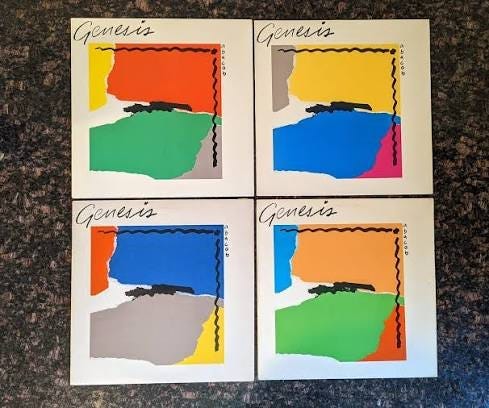
What we heard, at the time, was that Atlantic would “land” on one of the designs to print in perpetuity as its catalog entry… after the opening weeks of initial release had passed, that is. I distinctly remember a couple fellow employees and I “rolling the dice” on exactly just what we wanted to do about this unique event: Pick one design we think will eventually land as the “forever” cover, or pick the three we think might end up the “axed” ones, and thus, become collector’s items (”we’ll be rich if we pick the 3 covers they’ll never produce again!”). I simply chose to pick the one I wanted as my own. I must’ve spent a solid minute scouring each one, as if I was picking out the color of a new sofa for the living room! I can’t remember which I chose, but of the 4 above, I’m thinking it was one of the two right-hand ones.
M: What was your gut reaction to that opening title track? How did that experience compare with what you expected from Genesis at that point in their history?
B: I’m guessing my first listen to the album was in-store upon unboxing and pricing them. “Here, slap this on the turntable at the front!”
I’m sure I was riveted by the initial driving tempo, Phil’s drumming, and Tony’s distinctive organ flourishes. By this point, they could sneeze in harmony, and I’d be transfixed! Anticipating where I think you’re going, I was not at all turned off by their decidedly pulsing, what-might-be-called ‘80s sound! Their album, Duke, released the year before (and I enjoyed, as well), is known as their first post-’70s, non-prog, ‘80s “hit era,” although we wouldn’t have that particular rear-view mirror view for several more years’n’albums!
M: That’s true. Perhaps a lot of the questions that come next are built through hindsight benefits, but what can you do … it’s my only lens through which to view any of this. Anyway, back to the actual question: In light of that prog-to-pop transition tee-up, did Abacab feel like a natural next step to you, or did it feel like a more decisive break from what came before?
B: I think from Duke, this felt like a relatively natural next step. Going from … And Then There Were Three to Dukemight’ve been more ear-opening! But, I happily “adjusted” and loved it all! I’ve said this many times all over the ‘net and over the years, Matt… If you’re a ‘70s prog Genesis fan, and suddenly jettison them because of their ‘80s-era, Phil-driven hit era, you must not have been a really devoted Genesis fan to begin with! To “bring it home,” to me, your favorite musical artists are like your friends: If you love what they do and what they say, and enjoy being around them, it’s doubtful you’ll drop them just because they pick up a new hobby you might not be a fan of.
To me (and to help explain to the unbelievers), the Genesis members are, and always have been, supremely gifted songwriters (it’s how they met as Charterhouse schoolboys, after all), who were “forced” to write 2-minute Bee Gees-like love songs by their first producer, Jonathan King, who discovered them. When left to their own devices, they effortlessly slid into more long-form, exquisitely crafted suites celebrating the English countryside, fantastical fairytale fare, apocalyptic overseers… oh, and wacky wordplay! Although these new, early-’70s songs weren’t standard, radio-friendly 3-minute love songs, they didn’t make their songwriting any less riveting, cleverly crafted, melodic, or emotionally gripping. “The Cinema Show,“ for example, played like a 3D mega-pixel Dali painting-as-movie.
M: I agree with you, but after scrolling through some contemporary reviews, it doesn’t seem like the majority opinion. What were customers saying when they came in asking for this record back in the day? Were those longtime fans excited, confused, maybe annoyed? What was the anecdotal read on whether the record was good or not?
B: At the time, this was all too early for these assessments... especially since this one followed Duke. And, I don’t even recall much discussion about that album from customers, coming out of the more “stretched-out” Genesis from the ‘70s. I really think all this was weighed out and debated much further into the decade, after more and more Collins (solo and Genesis) hits had landed, and a kind of “This really seems like this is their thing” malaise had settled over the band and their fans (and exes).
As for bands (not talking solo artists like George, Michael, Madonna, et al) in the decade of the ‘80s, Genesis firmly belongs in the grouping of other high-profile, hit-making bands that usually first come to mind, especially when musical creativity, melodic sophistication, expanding the notion of pop songcraft, and adjusting seamlessly into the more danceable, gated drum-sound, synthy video decade: Duran, ABC, Spandau, Tears for Fears, Scritti Politti….Genesis.
M: Was there a moment where you could tell this record was going to be a hit versus “just another Genesis release?”
B: Had you asked me that question in mid-August ‘81 (when I’m sure I heard the “Abacab” single upon its release a month before the album), I can’t imagine not thinking it would be a hit! That pulsing bass (or bass pedal), Phil’s drums, Tony’s synth line, and Rutherford’s sinewy opening guitar…only news/talk stations weren’t gonna play this!
M: And even they would be so lucky to come out of an ad break reading whatever bulletin over such a hot track, my GAWD. Let’s take a moment to acknowledge Hugh Padgham’s gated reverb drum sound, which has lived on as a sonic influence for a lot longer than this album, I think. Did that register as a big deal at the time, or is that a retrospective observation that’s easier to make in view of their entire catalog, not to mention Gabriel and Collins’ solo work?
Brad: I was aware of Padgham and his ‘70s work on several Genesis albums (engineering and/or producing), but knowing anything about gated drums was, I think, out of everybody’s line of sight, save for those really recording-studio savvy. I just knew I enjoyed the sound, whatever they called it! I’m sure most people who knew to point that out wouldn’t be doing so until well into the ‘90s.
M: “No Reply at All” brought in the Phenix Horns (known for their longstanding relationship with Earth, Wind & Fire, which was a pretty bold pivot for a band still carrying a sort-of prog reputation. Was that a topic of discussion? If so, what was the reaction to this element specifically?
B: I think those who were following Phil’s solo career (many would never be, and had not been, Genesis fans) quickly became aware of Phil’s penchant for classic Motown, R&B, and soul in general, with a frequent desire for punching up his solo songs with horns. For those who might’ve been following solo Phil, it wouldn’t have been surprising to see the Phenix Horns show up on Genesis albums!
M: Where does Abacab land for you against Duke, the album right before it? In the context of their entire studio discography?
B: Of the two, I think I much prefer Duke, as (in retrospect, anyway) it seemed so much more to have a foot back into the ‘70s, while giving us just a hint to their imminently forward direction. Favorite songs on Duke include “Turn It On Again,” “Behind the Lines,” “Duchess,” and “Duke’s Travels.” As for their catalog, I’d wonder if Abacab would even find a place in my Top 10. That’s less a scathing indictment of one album as it is an enthusiastic nod to their vast catalog of stunning albums I enjoy!
Matt again: Should Brad and I come back for a full-on Genesis studio album deep dive? Yay or nay this idea in the comments section.
M: Looking back, do you think Abacab gets undersold in the Genesis story because it sits in this weird grey area after The Lamb Lies Down on Broadway but still a few years before “Invisible Touch?” Or does it earn its place as a transitional record on its own terms?
B: I’d say “yes” to your first question and “probably not” to your second. For those who do those sort of historical touchstones, I’d say they’d be more likely to finger Duke as the band’s first hint at “going straight” (abandoning long-form and embracing the charts), with Invisible Touch being more of a “stereotypical” ‘80s Genesis album, if critic-types had to choose one from the era
Epilogue
For those who want the usual helping of commercial data points: Abacab became Genesis’s first UK number one album and their first US Top 10 entry, peaking at No. 7 on the Billboard 200. It later went 2x Platinum. The title track alone reached No. 9 on the UK singles chart and No. 26 on the Billboard Hot 100, staying in the American Top 40 for six weeks. Modest by the group’s later standards, but impressive nonetheless.
Thanks again to Brad for doing this! Please praise him in the comments and also share any Genesis thoughts you may have.
